|
Home
|
Sep 18, 2026
This week’s themeWords you might be tempted to emend This week’s words evert villein rosery mordent decedent 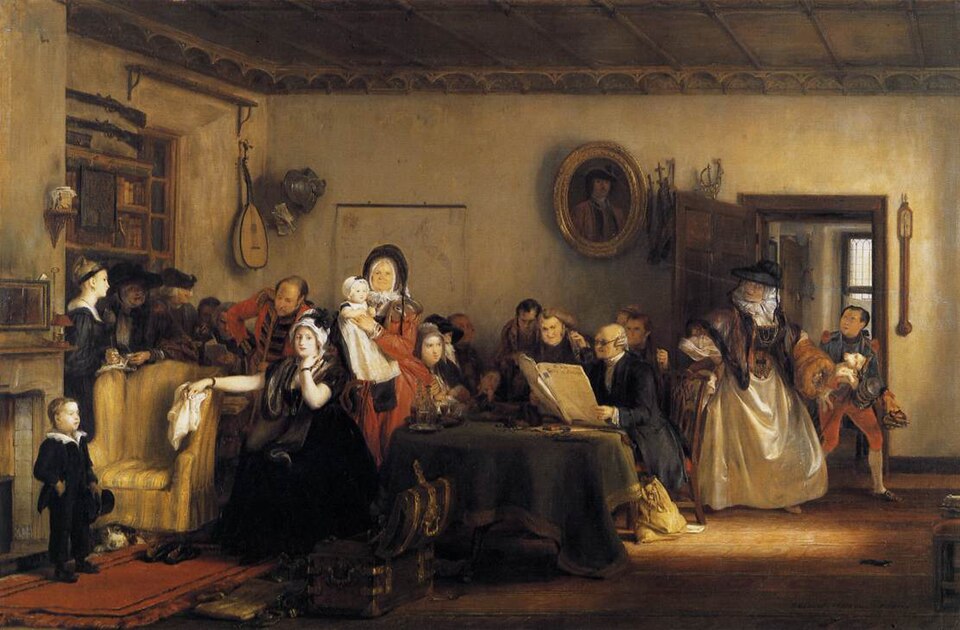
Reading the Will, 1820
Art: David Wilkie Next Week Autumn Contributing Membership Drive Wordsmith Games
A.Word.A.Day
with Anu Gargdecedent
PRONUNCIATION:
(di-SEE-duhnt)

MEANING:
noun: A person who has died.
ETYMOLOGY:
From Latin decedens (departing), from decedere (to depart, to die), from
de- (away) + cedere (to go, yield). Earliest documented use: 1599.
NOTES:
Decedent is used chiefly in legal contexts, especially in matters
of wills and estates. In the case quoted below, Charlotte Stafford provided
$100,000 in trust to ensure a decadent lifestyle for her cat, Kissie Meouw
Stafford, and deliberately excluded her three nephews from her will. They
challenged the will and lost. The cat got the cream; the nephews got lawyers. Decadent ultimately comes from Latin decadere (to fall away), built on cadere (to fall). Decedent comes from Latin decedere (to depart, to die), built on cedere (to go). The words share a prefix, but their roots take different paths. USAGE:
“By all accounts, decedent was a very intelligent, private, and
strong-willed woman who ‘ran her life the way she wanted to run it.’” Matter of Stafford; New York Supreme Court, Appellate Division, Third Department; Nov 27, 2013. See more usage examples of decedent in Vocabulary.com’s dictionary. A THOUGHT FOR TODAY:
Extended empires are like expanded gold, exchanging solid strength for
feeble splendor. -Samuel Johnson, lexicographer (18 Sep 1709-1784)
|
|
Subscriber Services
Awards | Stats | Links | Privacy Policy
Contribute | Advertise
Awards | Stats | Links | Privacy Policy
Contribute | Advertise
© 1994-2026 Wordsmith