|
Home
|
Oct 27, 2026
This week’s themeEponyms from antiquity This week’s words Herodian 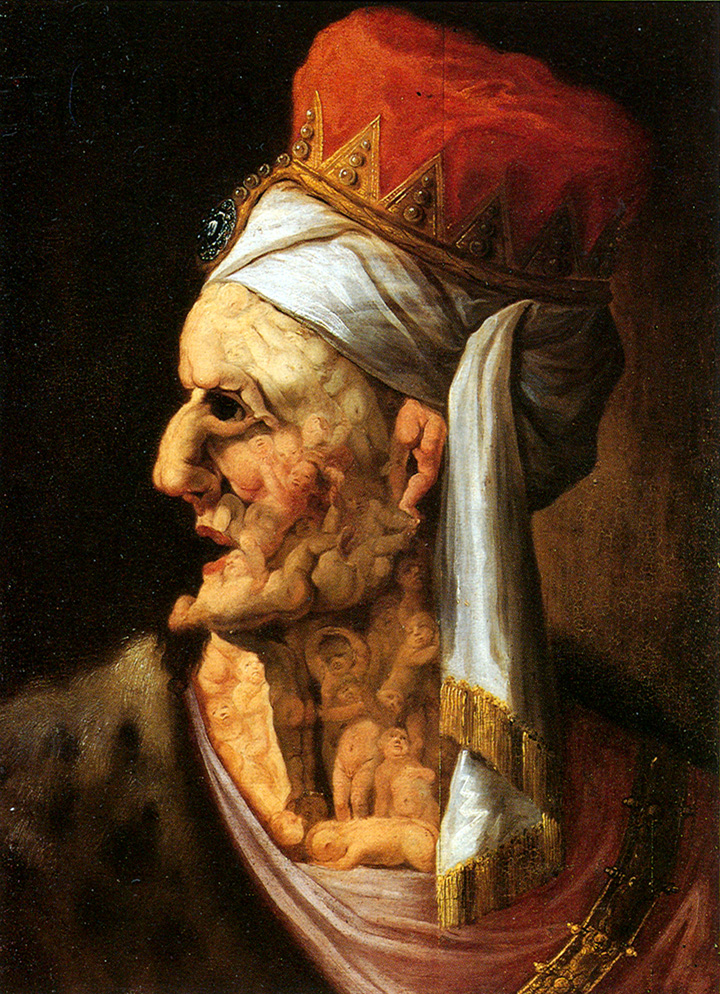
Head of Herod, 17th c.
Herod’s face and neck are composed of children’s bodies, alluding to the Massacre of the Innocents. Art: Unknown artist, in the manner of Giuseppe Arcimboldo Wordsmith Games
A.Word.A.Day
with Anu GargHerodian
PRONUNCIATION:
(huh-ROH-dee-uhn)

MEANING:
adjective: 1. Cruel; tyrannical. 2. Pompous or bombastic. ETYMOLOGY:
After Herod the Great (c. 73-4 BCE), king of Judea under Roman authority.
Earliest documented use: 1581.
NOTES:
Herod didn’t spare his own household: he had his favorite wife,
Mariamne, and three of his sons executed. The Roman emperor Augustus
reportedly quipped, “It is better to be Herod’s pig than his son.”
A killer pun: in ancient Greek, “pig” is hus and “son” is huios. The
joke rests on the Jewish prohibition against eating pork. (Herod practiced
Judaism.) According to the Gospel of Matthew, Herod, fearing a rival to his throne, ordered the killing of all boys aged two and under in and around Bethlehem. This episode, known as the Massacre of the Innocents, lacks independent historical corroboration. The pompous sense recalls the ranting, blustering Herod of medieval religious drama. This theatrical tradition also gave us the verb out-Herod. As a noun, Herodian refers to a member of a group portrayed in the Gospels as opponents of Jesus, generally understood as political supporters of Herod’s son Antipas. USAGE:
“As an infant Harry survived Voldemort’s herodian attack to become ‘the
chosen one’.” Bill Wylie-Kellermann; Harry and the Principalities; Sojourners Magazine (Washington, DC); Nov 2011. “A gangbanger violently braying his self-importance and the Herodian insistence that no one was more important than he himself.” Daily News (Los Angeles, California); Jan 12, 1997. A THOUGHT FOR TODAY:
This country will not be a permanently good place for any of us to live in
unless we make it a reasonably good place for all of us to live in.
-Theodore Roosevelt, 26th US president (27 Oct 1858-1919)
|
|
Subscriber Services
Awards | Stats | Links | Privacy Policy
Contribute | Advertise
Awards | Stats | Links | Privacy Policy
Contribute | Advertise
© 1994-2026 Wordsmith